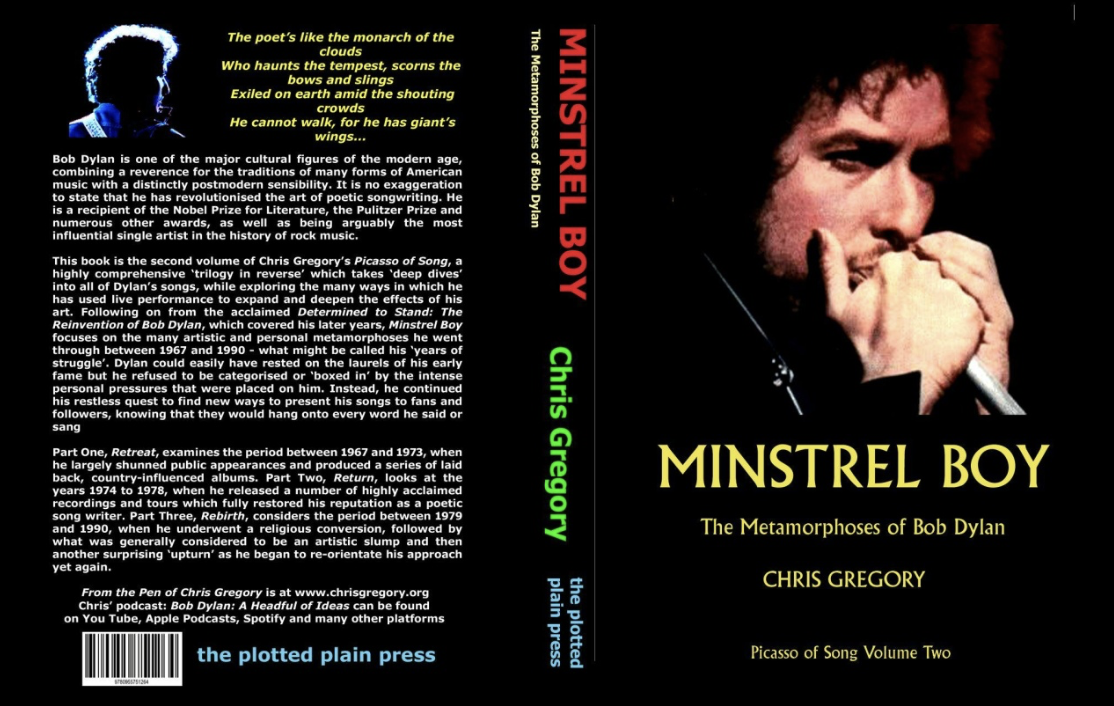
Some artists paint eras with colors so new they remap the eye. Dylan did it with sound and syntax. In Minstrel Boy: The Metamorphoses of Bob Dylan, arriving October 2025, Chris Gregory sets out to chart the mercurial cartography of 1967–1990, those fugitive decades when Dylan traded the bullhorn for a whisper, then returned with a roar, then found a different voice altogether.
Gregory’s method is part x‑ray, part invitation. He reads the songs as poems with pulse, their roots tangled in folk and blues soil, their branches brushing the King James Bible, Blakean skies, and the neon glare of American show business. He keeps the record spinning and the lights up: studio craft is weighed beside the drama of live performance, guitar strings thrumming against the echo of a choir, a harmonica cutting through weather and time.
Retreat, Return, Rebirth—three stages that are less a linear march than a spiral. In Nashville’s soft glow, a songwriter learns the virtue of restraint. In the mid-’70s, a stage becomes a forge. At the turn into the ’80s, the sacred storms the citadel of the self. Gregory does not tell you what to believe; he lets you hear it happening.
This is the second movement in his Picasso of Song trilogy, an audacious project written backwards, starting with Dylan’s later years (Determined to Stand) and winding toward the beginning. Gregory’s voice is fluent in the languages that formed the songwriter—blues cadences, country stoicism, gospel fervor, rock and roll swagger—but it is also hospitable, lucid, and amused, happy to entertain competing readings. He honors the mystery without turning it into fog.
Minstrel Boy isn’t a monument; it’s a key. It doesn’t seal Dylan off in amber. It opens doors you thought you knew, and a few you didn’t.